
How Humans Win
Our agency, humanity, and standards in the age of AI | Vol. 81

Welcome to Vol. 81 of Move Fast, Think Slow.
In this week’s dispatch we are switching it up with a guest appearance from the great Bobby Edwards. I had asked him if he’d be keen to write something up for MF/TS on the state of the state and he took me up on it. 🤗
I met Bobby while at Giant Spoon, the Ad agency I’ve called my work home for the past seven years. Bobby is one of the sharpest, most curious, and diligent minds I ever worked with. Today, he leads strategy on American Express at UM Worldwide, helping a premiere financial company sustain and grow their position in the marketplace.
So without further ado, dive into this week’s MF/TS by Bobby Edwards.
Look out, it’s another AI read. But this one is different. It’s not just the one you’ll want to read, it’s the one you need to read. At least before our lives are optimized into a dashboard and summarized back to us as a weekly report. 🤪
This is “How Humans Win”.
The Creds:
More than half (61%¹) of American adults have used AI in the past 6 months. Nearly 1 in 5¹ rely on it every day. Scaled globally, that’s over a billion people who have used AI, and hundreds of millions using it daily.
We’ve passed the tipping point and progressed from curiosity to infrastructure. Cool.
The Tension:
Only 17% of Americans believe AI will positively impact society over the next twenty years. 56% of AI experts feel the same². Talk about a gap. Also. Twenty years?!
It took Netflix over 10 years to reach 100 million users³. Spotify over 4 years. It took ChatGPT less than 3 months. Yet this AI arms race, and a barrage of speculating, predicting, and anticipating the future, floods all social platforms and news publications. We can’t possibly know what will happen in the next 20 years, let alone 20 months.
So what can we do? More specifically, what can you do?

You can focus on you, and you can do it now.
Quick disclaimer - future proofing is necessary. It’s what many, if not all, of our jobs require and there is no escaping that. But this obsession with what’s next is the fastest way to miss what is happening right now.
Humans are winning.
I don’t mean the human collective. And I definitely don’t even mean at scale; jobs are being replaced by AI every day. However, there are humans out there that are winning and you should be one of them. You need to be one of them. Otherwise, the concerns of the remaining 83% - those who don’t believe AI will be a net positive - will become a reality for you. And it will happen swiftly with no remorse. You can submit if you want. Or you can ascend.
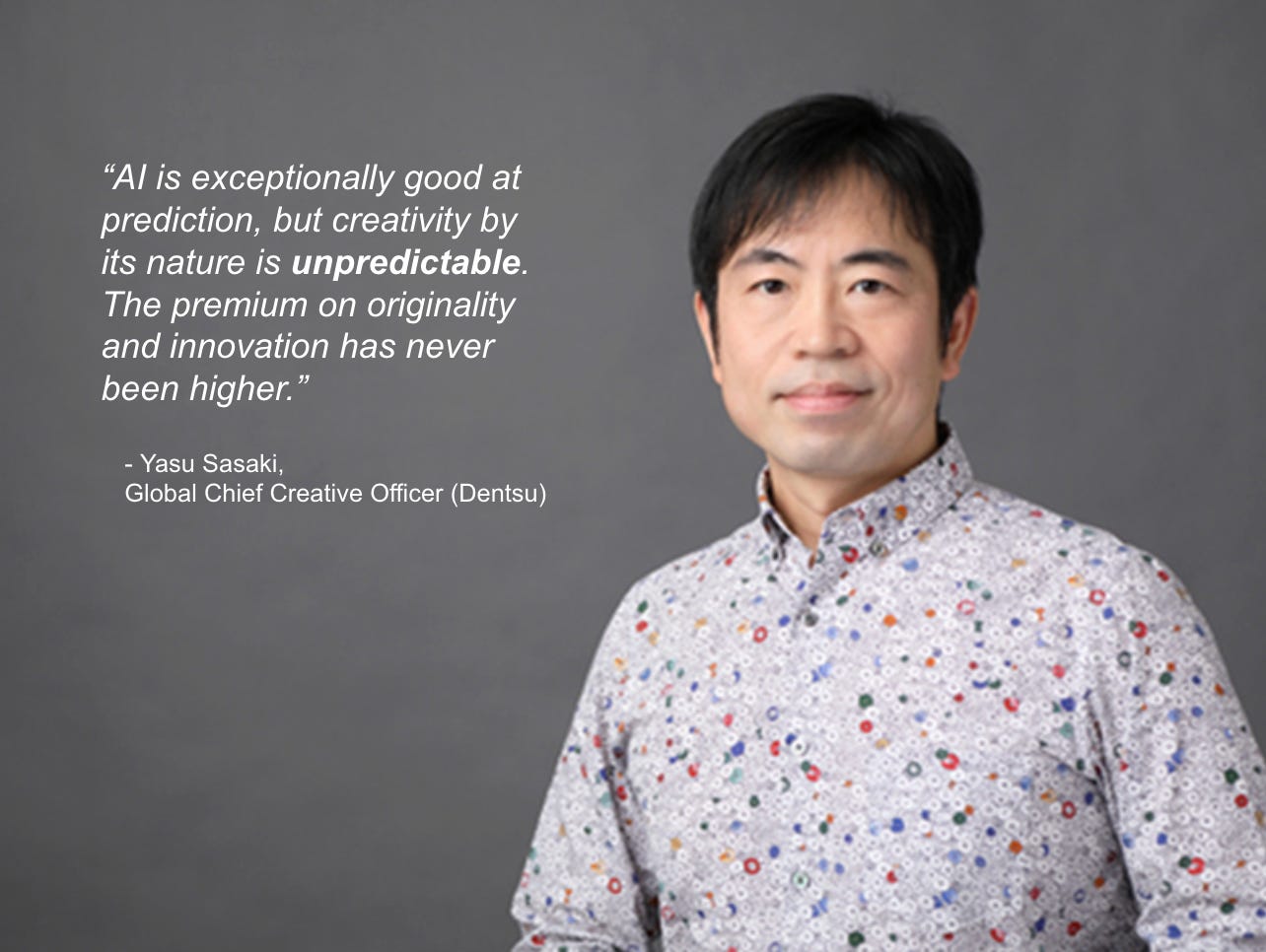
Yasu hits the nail on the head with the statement above. The thing is, this unpredictability doesn’t only apply to creative. There is an irreplaceable human element in most jobs, and that’s where opportunity lies.
You need to find it in yours.
Check out Shae O. Omonijo’s work if you need a spark. Her video on Critical Thinking in the Age of AI will challenge your current mindset. She addresses how AI depends entirely on us - on humans. Our books, our lectures, our songs, our conversations. “You’re talking to a mirror of human-generated content” when you speak to AI. Artificial intelligence is predictive in its response, but it can’t think. And it definitely can’t conduct deep critical thinking. That’s a purely human ability.
Just take a look at the evolution of AI. For a long time, the goal of advanced AI was to think like a human. To reason, feel, and understand the world the way we do. Being intelligent meant being human-like.
That goal has quietly changed.
OpenAI and researchers like Geoffrey Hinton and Yoshua Bengio (note: if AI had a list of “founding fathers” they’d undoubtedly be near the top) are redefining intelligence as “the ability to outperform humans at economically valuable tasks.” Not understanding. Not judgment. Not meaning. Just productivity at scale.
In other words, AI doesn’t need to be human anymore. It just needs to be useful.
The danger isn’t that machines become more human. It’s that we start measuring ourselves the same narrow way: by tasks completed, outputs produced, and value priced by a market. If intelligence is now defined by task efficiency, AI will always win at the parts of work that are predictable, repeatable, and measurable.
But the most human parts of work, like judgment, taste, empathy, creativity, and the ability to make sense of ambiguity, don’t fit neatly into a task list or a spreadsheet. Those things don’t scale cleanly. And that’s exactly why they matter more now, not less.
If you build your value around tasks, you’re competing with machines on their terms.
If you build your value around human insight, you’re operating in a category machines can’t enter.

Know Your Kid (and Yourself)
I’ll spare you the rant about how right now many industries, especially Marketing, need strategists. How the roles that feel farthest from the bottom line and are easiest to cut first are often the exact ones companies desperately need.
Instead, I’ll focus on the single most human job in the world - being a parent.
I have two little dictators at home (I say this with the utmost love; being a parent is my favorite job and it’s not even close). My daughter is almost four and my son recently turned one. My wife and I are in the sleep deprived, beautifully chaotic early years that are both the hardest and best of our lives.
We’ve read the books. We’ve listened to the podcasts. We’ve spoken with countless doctors, other parents, even the wall a few times during particularly long nights. Guidance is abundant but do you want to know the one, single piece of advice everyone defaults to?
“You know your kid.”
That’s it. That’s the safety net. There are countless studies, best practices, tips, tricks…the list goes on. An entire INDUSTRY built on making sense of things. But at the end of the day, consensus is that you just have to know your kid.
There it is, the irreplaceable human element.
For fellow parents out there, I hope this makes it all make sense in your day job. And for those that aren’t parents, at least take this anecdote with a grain of salt and please enjoy your full night of sleep tonight.
In either case, my push for you is to find that “you know your kid” element in your job. Think about that irreplaceable human element that’s unique to your role. Run with it. Get better at it. Evolve it. Perfect it. Then pull it apart and do it again.
If you need a starting point, MIT Sloan School of Management has a list (EPOCH) of capabilities that humans have and AI does not. It’s a quick read and will set you on the path to winning.
AI is redefining intelligence downward to what it can do best.
Your advantage is leaning into what it can’t do at all.
If an algorithm is reading this in twenty years, that alone doesn’t mean AI won. Algorithms will exist. They always will. AI only wins if we decide that efficiency is intelligence, that output is judgment, and that being human is optional.
Choosing not to make those tradeoffs is how humans win. Go be one of the winners.
Sources: MenloVentures¹, Pew Research², BOND³
VISUALS OF THE WEEK

Go forth.
Stay safe.
Ride the wave.
-Mitch